
Love Jihad’ Not Defined Under Central Law; Allegations Of Religious Conversion Absent: Calcutta High Court Refuses To Quash Criminal Case Against Police Constable
2026 (0) AIJEL-WB 547830
In the case of Md. Rafikul Islam & Ors. versus The State of West Bengal & Another, the Calcutta High Court, presided over by Justice Ajay Kumar Gupta, dismissed a criminal revisional application filed by the petitioners seeking to quash proceedings against them under various sections of the Indian Penal Code (IPC). The case stemmed from allegations made by the de facto complainant, who accused the first petitioner, a police constable, of impersonation, deception, and physical assault, among other charges.
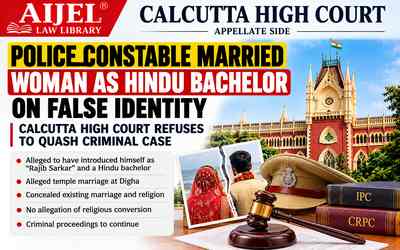
The complainant alleged that she was misled by the petitioner, who introduced himself as 'Rajib Sarkar', a Hindu bachelor, while concealing his true identity as Md. Rafikul Islam, a Muslim already married with children. The complainant claimed that they entered into a relationship based on false pretenses, leading to physical intimacy and a purported marriage in May 2021. Following the revelation of his true identity, the complainant alleged that she was subjected to physical abuse and confinement, resulting in a miscarriage.
The petitioners contended that the allegations were fabricated and that the complainant had concealed her own marital status. They argued that any physical relationship was consensual and that the complainant was attempting to extort money from the petitioner. The petitioners also highlighted that a departmental inquiry against the first petitioner had not substantiated the allegations, arguing that this should impact the criminal proceedings.
The court, however, found that the allegations, including those of assault and non-consensual sexual intercourse, were serious and warranted further investigation. It noted that the relationship's dynamics, including the alleged deception regarding identity and marital status, raised significant legal questions that could not be resolved without a full trial. The court emphasized that the standard of proof in criminal cases differs from that in departmental inquiries, and the findings of the latter do not automatically negate the former.
Ultimately, the court ruled that the prima facie evidence presented was sufficient to continue the proceedings, dismissing the petitioners' claims of being falsely implicated. The court reiterated the importance of allowing the investigation to proceed and the necessity of a trial to ascertain the truth of the allegations. Consequently, the application for quashing the proceedings was denied, and the case was directed to continue in the trial court.