
Missing Train Ticket No Ground To Deny Compensation: Calcutta High Court Awards ₹8 Lakh To Family Of Passenger Who Fell From Overcrowded Local Train
2026 (0) AIJEL-WB 547831
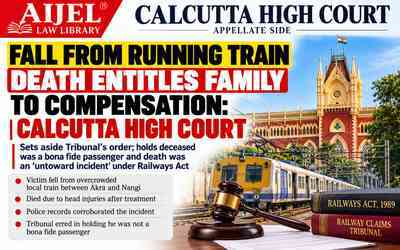
In a significant ruling, the Calcutta High Court, presided over by Justice Biswaroop Chowdhury, has allowed an appeal filed by Sudama Mahato and another against the Union of India, granting them compensation of Rs. 800,000 under Section 124A of the Railways Act, 1989. The judgment, delivered on October 13, 2026, overturned a previous decision by the Railway Claims Tribunal which had dismissed their claim.
The case arose from a tragic incident on July 16, 2022, when the victim, Sharawan Kumar, fell from a running train while traveling from Brace Bridge to Budge Budge. The victim was reportedly on his way to visit the Kali Temple in Kalighat and was accompanied by friends. Witnesses indicated that he lost his balance due to overcrowding in the train compartment and sustained severe head injuries, leading to his death two days later.
The Railway Claims Tribunal had dismissed the claim, stating that the appellants failed to prove that the victim was a bona fide passenger and that the incident constituted an 'untoward incident' as defined under the Railways Act. The Tribunal noted the absence of a journey ticket and questioned the credibility of the evidence presented by the appellants.
In the appeal, the appellants argued that the evidence, including police reports and witness testimonies, supported their claim that the victim was indeed traveling on the train. They contended that the Railway Authority had not provided sufficient evidence to counter their claims, particularly regarding the absence of a ticket. The appellants highlighted that the post-mortem report indicated the victim was admitted to the hospital with a history of falling from a moving train.
The respondent, Union of India, maintained that the appellants could not establish the victim's presence on the train and pointed out that no ticket was recovered. They argued that the evidence presented was insufficient to prove that the victim had fallen from the train.
Justice Chowdhury, in his analysis, emphasized that the Railways Act is a beneficial legislation aimed at protecting the rights of passengers. He noted that while the absence of a ticket is a factor, it does not automatically negate the claim of being a bona fide passenger. The court referred to several precedents, including Union of India vs. Rina Devi, which established that the burden of proof shifts to the Railways once the claimant provides sufficient evidence of the incident.
The court found that the cumulative evidence, including witness testimonies and the circumstances surrounding the incident, sufficiently established that the victim was a bona fide passenger who died due to an untoward incident. Consequently, the court set aside the Tribunal's order and directed the Railway Authority to pay the compensation amount along with interest.
This ruling underscores the judiciary's commitment to ensuring that victims of railway accidents receive just compensation, reinforcing the principle that the absence of a ticket does not preclude a claim for compensation under the Railways Act.