
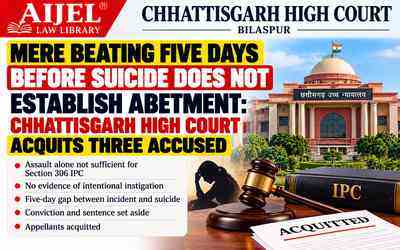
Mere Beating Five Days Before Suicide Does Not Establish Abetment Without Intent To Instigate: Chhattisgarh High Court Acquits Three Accused
2026 (0) AIJEL-HC 2015749
The Chhattisgarh High Court, in a judgment delivered by Justice Naresh Kumar Chandravanshi, has acquitted the appellants in a case concerning the abetment of suicide under Section 306/34 of the Indian Penal Code. The appellants, Smt. Lakhapatiya Bai and Mandip Ram, were previously convicted and sentenced to ten years of rigorous imprisonment by the Second Upper Sessions Judge, Sarguja, for allegedly causing the suicide of Ku. Anita Ravi.
The case stemmed from an incident on April 13, 2009, when the deceased, Ku. Anita Ravi, was reportedly assaulted by the appellants while she was with her fiancé, Abhay Kumar Bhaskar, at his residence. Following this incident, Ku. Anita consumed poison on April 18, 2009, leading to her death. The prosecution argued that the assault and subsequent humiliation led to her suicide, thus constituting abetment.
During the trial, the prosecution presented 11 witnesses and various documents, including a suicide note allegedly written by the deceased. However, the defense contended that the prosecution failed to prove the authenticity of the suicide note and the circumstances surrounding the alleged assault. The defense argued that the incident was merely a verbal altercation and did not amount to abetment of suicide.
The High Court, upon reviewing the evidence, noted that while the appellants had indeed objected to the couple's presence together, there was no clear evidence of intent to instigate Ku. Anita to commit suicide. The court emphasized that for a conviction under Section 306 IPC, there must be a clear mens rea or intention to drive the victim to suicide, which was not established in this case. The court referenced several precedents, asserting that mere allegations of harassment without direct instigation do not suffice for a conviction under the abetment statute.
Ultimately, the court found that the prosecution had not met its burden of proof, leading to the conclusion that the appellants were wrongfully convicted. The appeal was allowed, and the conviction and sentence were quashed, resulting in the acquittal of the appellants. The court also ordered that the bail bonds of the appellants remain in operation for an additional six months following the judgment.