
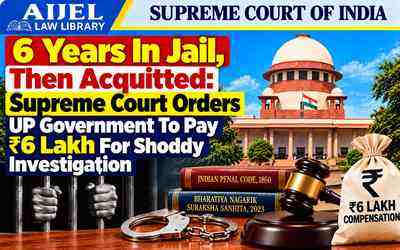
Six Years In Jail Due To Shoddy Investigation: Supreme Court Awards ₹6 Lakh Compensation To Acquitted Murder Accused.
2026 (0) AIJEL-SC 77817
In a significant judgment, the Supreme Court of India addressed the grave shortcomings in the investigation of a kidnapping and murder case, resulting in the wrongful imprisonment of Arun @ Deepak for six years. The petitioner sought bail after being in custody since November 14, 2019, under FIR No. 367 of 2019, which charged him under Sections 364, 302, and 201 of the Indian Penal Code, 1860.
The Court, upon reviewing the case, noted that the prosecution's case was based solely on circumstantial evidence. The petitioner was not named in the FIR or in the initial statements given to the police. His identification as an accused stemmed from CCTV footage and a co-accused's confession, which were both deemed unreliable. The Court directed the trial to conclude within three months, leading to the petitioner's acquittal.
The investigation was heavily criticized for its inadequacy. Only six witnesses were examined, and crucial evidence, such as the identification of the deceased's remains and the motorcycle linked to the crime, was not properly substantiated. The prosecution's reliance on a ransom demand, which was never reported to the police, and the lack of medical evidence regarding the cause of death further weakened the case.
The trial court found that the prosecution failed to prove any of the four key circumstances it presented, including the alleged ransom demand, the confession of the accused, the last seen theory, and the electronic evidence. The Court highlighted that the investigation lacked basic procedural rigor, with no forensic examination of the recovered items and no proper identification of the accused.
In light of these findings, the Supreme Court condemned the manner in which the investigation was conducted and the prosecution pursued. It emphasized the need for law enforcement to ensure justice for both victims and the accused, stating that the system must not merely aim for convictions but uphold the presumption of innocence.
As a form of reparation for the wrongful imprisonment, the Court ordered the State of Uttar Pradesh to pay Rs. 6,00,000 to the petitioner within one month, with interest accruing at 18% per annum if the payment was delayed. This ruling serves as a stark reminder of the responsibilities of the investigative and prosecutorial agencies in safeguarding the rights of individuals within the justice system.