
“Fraud Vitiates All Solemn Acts”: Supreme Court Rejects Private Claims Over 550 Acres Of Valuable Miyapur Land In Telangana, Upholds State Ownership
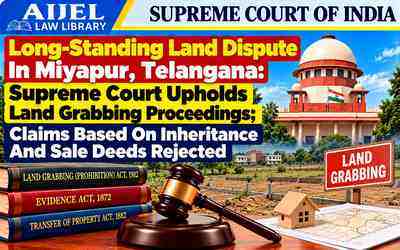
2026 (0) AIJEL-SC 77836
In a significant judgment delivered on October 29, 2026, the Supreme Court of India, presided over by Justice M. M. Sundresh, dismissed a series of civil appeals concerning land ownership disputes in Miyapur, Telangana. The appellants, led by Bandari Ramchander, challenged the High Court of Andhra Pradesh's decision from April 16, 2003, which upheld the findings of a Special Court that declared the appellants as land grabbers and affirmed the state's ownership of the disputed lands.
The case involved multiple parties claiming title and possession of lands situated in Survey Nos. 100 and 101 of Miyapur Village, with a history dating back to 1912. The lands were classified as Sarkari poramboke, indicating government ownership. The Special Court had previously ruled in favor of the state in several land grabbing cases, including LGC Nos. 110/1994, 131/1995, and 136/1995, while dismissing claims made by the appellants.
The Supreme Court noted that the appellants had filed appeals despite not being parties in the earlier proceedings before the Special Court and the High Court. The court emphasized that the lands in question had been declared as government property and that the appellants' claims were based on historical documents and assertions of inheritance, which were insufficient to establish title.
The judgment highlighted the legal framework surrounding the abolition of jagirs in Telangana, specifically referencing the Andhra Pradesh (Telangana Area) (Abolition of Jagirs) Regulation, 1358 Fasli, which transferred ownership of jagir lands to the state. The court ruled that any rights previously held by the jagirdars were extinguished upon the regulation's enactment, and the appellants could not claim ownership based on historical grants or documents that were rendered invalid by subsequent legislation.
The court also addressed the arguments presented by the appellants regarding their claims of adverse possession and the validity of revenue records that purportedly recognized their ownership. It found that the revenue entries were made without proper authority and were thus invalid. The court concluded that the appellants' attempts to assert ownership were based on fraudulent claims and that the state had established clear title to the lands.
Ultimately, the Supreme Court dismissed all appeals, affirming the High Court's ruling and the findings of the Special Court. The court underscored that the attempts to usurp state-owned lands were without merit and that no equitable relief could be granted in favor of the appellants, given their lack of legitimate title. The judgment serves as a critical precedent in land ownership disputes, particularly in the context of historical claims and the implications of land reform legislation.