
Land Acquisition Does Not Lose Public Purpose Merely Because Private Company Benefits: Chhattisgarh High Court Upholds Railway Project Linked To Shree Cement
2026 (0) AIJEL-CH 2015762
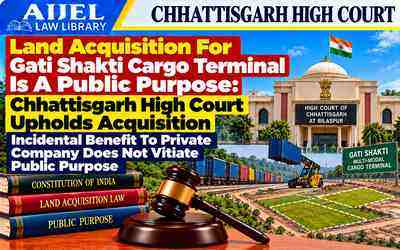
The High Court of Chhattisgarh has dismissed multiple writ petitions challenging the land acquisition proceedings initiated for the Gati Shakti Multi-Modal Cargo Terminal Project. The petitions were filed by various agriculturists whose lands were proposed for acquisition under the Railways Act, 1989. The petitioners contended that the acquisition was not for a genuine public purpose but primarily to benefit a private entity, Shree Cement Pvt. Limited.
The court noted that the acquisition was part of a Special Railway Project aimed at enhancing railway connectivity from Hathbandh Railway Station to Khaparadih Village. The petitioners had previously submitted objections under Section 20-D of the Railways Act, which were rejected by the competent authority in a summary manner. They argued that the authority failed to conduct a proper inquiry or provide a reasoned order, as mandated by law.
In its judgment, the court emphasized that the acquisition process followed the statutory framework of the Railways Act. It acknowledged that while the project would benefit a private company, this did not negate its public purpose. The court highlighted that the land acquired would vest in the Central Government and that the railway infrastructure would remain under public control.
The court also addressed the petitioners' claims regarding the impact of the project on their agricultural lands, stating that deprivation of property under the law does not equate to an absolute right to prevent acquisition. The court reiterated that the statutory right to object does not guarantee acceptance of those objections.
Ultimately, the court found no jurisdictional error or procedural irregularity in the acquisition process and dismissed the petitions, allowing the project to proceed. The petitioners were reminded that they could still seek compensation under the provisions of the Railways Act. The interim orders previously granted were vacated, and the court did not impose any costs on the parties involved.