
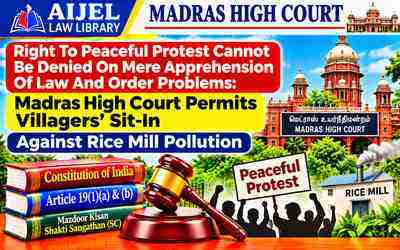
Right To Peaceful Protest Cannot Be Denied On Mere Apprehension Of Law And Order Problems: Madras High Court Permits Villagers' Sit-In Against Rice Mill Pollution.
2026 (0) AIJEL-TN 1299393
The Madras High Court, in a judgment delivered on October 15, 2026, addressed the right to protest in the context of environmental concerns raised by residents of Sitharkadu village against a rice mill operated by the Tamil Nadu Civil Supplies Corporation. The petition, filed by M.Anburaj, challenged the rejection of permission for a peaceful sit-in protest intended to draw attention to air pollution issues affecting the village.
The petitioner argued that the residents had been protesting against the pollution since 2006, with previous attempts to address the issue yielding no results. They sought to conduct a sit-in demonstration, termed 'Ulliruppu Porattam', at the cremation ground in Sitharkadu. However, hours before the protest was scheduled to begin, the local authorities denied permission, citing potential law and order issues.
The court emphasized that the right to protest is a fundamental expression under Article 19(1)(a) of the Constitution, and the right to assemble peacefully is protected under Article 19(1)(b). The court noted that the grounds for restricting such rights must be justified under Articles 19(2) and 19(3). It found that the residents' intention to protest peacefully to highlight environmental concerns was a legitimate exercise of their constitutional rights.
The court referred to the Supreme Court's ruling in the case of Mazdoor Kisan Shakti Sangathan v. Union of India, which recognized protests as essential outlets for societal grievances. The court stated that preventing peaceful protests could lead to heightened tensions within communities, thereby supporting the residents' right to hold their planned demonstration.
In its ruling, the court quashed the impugned order and allowed the villagers to conduct their sit-in protest with specific conditions to maintain peace and order. The court directed that the protest could commence on November 29, 2026, and stipulated that the organizers must ensure the protest remains peaceful, provide a list of participants to the police in advance, and allow for any rituals or ceremonies to take precedence during the protest.
This judgment reinforces the constitutional right to protest as a vital mechanism for citizens to express their concerns and hold authorities accountable, particularly in matters affecting public health and the environment.