
Laws Penalising People For Having More Than Two Children Have Lost Relevance As India's Fertility Rate Falls: Supreme Court Refers Issue To Larger Bench
2026 (0) AIJEL-SC 77867
In a significant judgment delivered on November 4, 2026, the Supreme Court of India addressed the constitutional validity of disqualifying candidates from contesting panchayat elections based on the number of children they have. The case arose when Mangala Bhimrao Ingle's election as Sarpanch of Kakoda Gram Panchayat was set aside due to her having three children, which was deemed a violation of Section 14(1)(j-1) of the Maharashtra Village Panchayats Act, 1959.
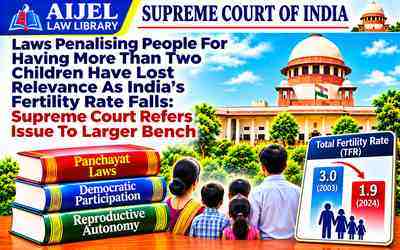
The Court noted that the laws penalizing individuals for having more than two children have lost their relevance in light of demographic changes over the past two decades. The judgment referenced the landmark case of Javed v. State of Haryana, which upheld similar disqualifications in 2003 based on concerns about population growth. However, the Court observed that since then, India's Total Fertility Rate (TFR) has fallen from 3.0 to 1.9, indicating a demographic transition that undermines the original rationale for such laws.
The Court emphasized that the assumptions underpinning the Javed decision, which linked population control to economic progress, are no longer valid. It highlighted that the current demographic reality necessitates a re-evaluation of laws that restrict political representation based on reproductive choices. The judgment pointed out that such restrictions disproportionately impact women and marginalized communities, raising concerns about reproductive autonomy and equality.
The Court expressed its intention to refer the matter to a larger bench for a comprehensive review of the Javed precedent, indicating that the continued operation of laws based on outdated assumptions may constitute an abuse of power. The interim order allows Ingle to continue serving as Sarpanch until the appeal is resolved, reflecting the Court's recognition of the need for laws to adapt to changing social realities.
This ruling marks a pivotal moment in the ongoing discourse surrounding reproductive rights and political representation in India, urging a shift from punitive measures towards policies that support democratic participation and individual autonomy.