
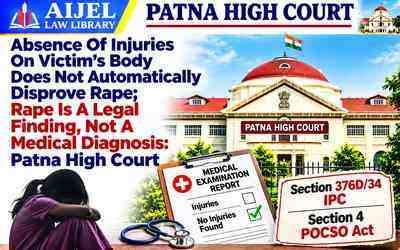
Absence Of Injuries On Victim's Body Does Not Automatically Disprove Rape; Rape Is A Legal Finding, Not A Medical Diagnosis.
2026 (0) AIJEL-PT 1773344
The Patna High Court, in a judgment delivered by Justice Chandra Shekhar Jha on October 29, 2026, dismissed a petition seeking to quash the cognizance order dated February 2, 2019, passed by the 1st Additional District and Sessions Judge-Cum-Special Judge, Jehanabad. The case arose from Jehanabad Mahila Police Station Case No. 02 of 2017, concerning serious allegations of gang rape against a minor girl.
The prosecution's case was initiated by a physical teacher whose deaf and dumb daughter was allegedly gang-raped by the accused on the roof of their school on January 15, 2017. The informant reported that her daughter was found bleeding, and she requested medical examinations to substantiate her claims. Following the FIR, the police conducted an investigation and submitted a final report against four named co-accused, including the petitioners.
The petitioners contended that they were falsely implicated due to personal animosities, arguing that the bleeding observed was a result of the victim's menstrual cycle, as opined by a medical board. They highlighted that no injuries were found on the victim's body that would indicate rape. Additionally, they pointed out that the police had initially submitted a closure report, which they argued should have precluded the taking of cognizance by the magistrate.
In response, the court noted that the FIR contained specific allegations against the petitioners, and the matter had escalated to the Human Rights Commission due to claims of police misconduct. The court emphasized that the absence of physical injuries does not negate the possibility of rape, as legal definitions of rape do not strictly rely on medical findings. The court cited precedents indicating that the determination of whether a rape occurred is a legal question, not solely a medical one.
Ultimately, the court found the cognizance order to be well-reasoned, based on the materials available, including the FIR, charge-sheet, and statements recorded under Section 164 of the CrPC. The petition was dismissed, allowing the case to proceed in the trial court.