
Proved Contradiction In Witness Testimony Does Not Make Earlier Police Statement Substantive Evidence: Supreme Court
2026 (0) AIJEL-SC 77883
In a significant judgment, the Supreme Court of India acquitted Naresh, who had been convicted for the murder of two widows, Suman and Shakuntla, by the Punjab and Haryana High Court. The Supreme Court's decision, delivered by Justice Satish Chandra Sharma, was based on the finding that the prosecution had failed to establish a complete chain of evidence linking Naresh to the crime.
The case stemmed from an incident on the night of April 17, 2011, when Suman and Shakuntla were found dead in their homes in village Ranila, Haryana. The prosecution alleged that Naresh, motivated by a belief that the women were involved in immoral activities, attacked them with a danda (stick) and later dragged their bodies into their houses. An FIR was registered based on a statement from a village panch, Kailash Chander, who claimed to have heard about Naresh's involvement.
However, during the trial, all key witnesses, including the informant, turned hostile and denied their earlier statements. The trial court relied on these statements despite their retraction, citing the principle that previous statements could be considered under certain circumstances. The High Court upheld Naresh's conviction but commuted the death sentence to life imprisonment, emphasizing the FIR's significance in establishing his involvement.
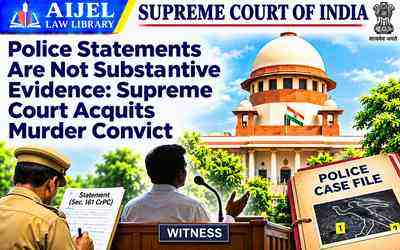
The Supreme Court, however, found that the FIR was based on hearsay and did not constitute substantive evidence. It ruled that the statements recorded under Section 161 of the CrPC, which were disowned by the witnesses, could not be used to establish Naresh's guilt. The court noted that the prosecution's case relied heavily on circumstantial evidence, which was insufficient to prove Naresh's involvement beyond a reasonable doubt.
The court also scrutinized the recoveries made at Naresh's instance, including a danda and a gandasi (a type of agricultural tool), and found that these items were not conclusively linked to the murders. The medical evidence indicated that the fatal injuries were caused by sharp-edged weapons, and the bloodstains found on the recovered items were inconclusive.
In conclusion, the Supreme Court held that the prosecution had not met the burden of proof required for a conviction, leading to Naresh's acquittal. The judgment underscores the importance of admissible evidence and the standards required for a conviction in criminal cases.