
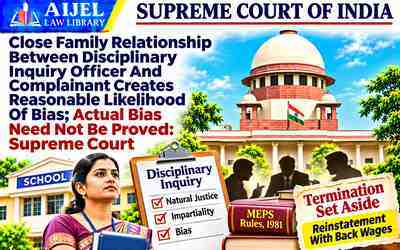
Close Family Relationship Between Disciplinary Inquiry Officer And Complainant Creates Reasonable Likelihood Of Bias; Actual Bias Need Not Be Proved: Supreme Court
2026 (0) AIJEL-SC 77906
The Supreme Court of India, in a judgment delivered on November 17, 2026, addressed the appeal of Ku. Kiran D/O Purushottam Bhujade against the High Court of Bombay's decision that upheld her termination from service. The Court restored the order of the School Tribunal, which had previously quashed the termination and directed her reinstatement with continuity of service and full back wages.
The case originated from the Appellant's appointment as an Assistant Teacher at Respondent No.2-School in 2009, which was approved by the Education Officer in 2015. Following a government resolution in 2016 granting grant-in-aid status to the school, the Appellant alleged that her name was excluded from salary grant bills, leading her to file complaints against the management. This prompted the management to initiate disciplinary proceedings against her, culminating in her termination in February 2022.
The School Tribunal initially set aside the termination order, citing a lack of evidence against the Appellant and highlighting procedural irregularities in the inquiry process. However, the High Court later reversed this decision, stating that the inquiry was conducted fairly and in accordance with the law.
The Supreme Court, upon reviewing the case, focused on the issue of bias in the inquiry process. It noted that the inquiry committee was composed of individuals closely related to the management, which created a reasonable apprehension of bias. The Court emphasized the principle that no one should be a judge in their own cause, highlighting that the roles of complainant, prosecutor, and adjudicator were intertwined within the same familial structure.
The Court found that the inquiry lacked the necessary impartiality, as the key witness against the Appellant was also a member of the inquiry committee. This familial capture of the inquiry process rendered it fundamentally flawed and incapable of ensuring a fair hearing.
Ultimately, the Supreme Court ruled that the inquiry proceedings were unsustainable in law due to the evident bias and restored the Tribunal's order for the Appellant's reinstatement. The Court also directed the Education Officer to explore the possibility of absorbing the Appellant in another grant-in-aid school, reinforcing the importance of fair treatment in educational employment.