
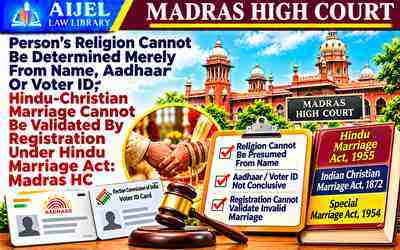
Person's Religion Cannot Be Determined Merely From Name, Aadhaar Or Voter ID; Hindu-Christian Marriage Cannot Be Validated By Registration Under Hindu Marriage Act: Madras High Court
2026 (0) AIJEL-TN 1299426
The Madras High Court, in a judgment delivered on November 19, 2026, addressed the validity of a marriage registered under the Hindu Marriage Act, 1955, between a Christian and a Hindu. The appeal, AS No. 79 of 2020, was filed against a decree from the V Additional Family Court, Chennai, which had dismissed the plaintiff's suit seeking a declaration that the marriage was null and void.
The plaintiff contended that he was a Christian at the time of the alleged marriage registration on February 20, 2009, and that the registration was conducted without his knowledge or consent, constituting fraud. He argued that the marriage was void ab initio as it contravened Section 5 of the Hindu Marriage Act, which stipulates that a valid marriage can only be solemnized between two Hindus.
Conversely, the defendant claimed that the plaintiff had expressed his love for her and that they had agreed to marry despite initial hesitations due to family opposition. She asserted that the marriage was solemnized in accordance with Hindu customs, although she later admitted during cross-examination that no such ceremony had taken place.
The Trial Court had dismissed the plaintiff's claims, primarily on the grounds of contradictions in his evidence regarding his religious status. However, the High Court found that the Trial Court had failed to appreciate the evidence properly, particularly the baptism certificates that established the plaintiff's Christian identity.
The Court emphasized that the Hindu Marriage Act does not permit the registration of a marriage between individuals of different religions. It noted that the registration of the marriage under the Hindu Marriage Act was erroneous, as the plaintiff was not a Hindu at the time of the marriage. The Court further highlighted the necessity of following the procedures outlined in the Indian Christian Marriage Act, 1872, or the Special Marriage Act, 1954, for marriages involving individuals of different faiths.
Ultimately, the High Court declared the marriage registered under Serial No. 157 of 2009 as null and void, emphasizing the importance of accurate registration practices by marriage registrars. The Court directed that a copy of the order be sent to the Inspector General of Registration to ensure compliance with legal requirements in future registrations. This ruling underscores the legal principle that marriages must adhere to the statutory frameworks applicable to the religions of the parties involved.