
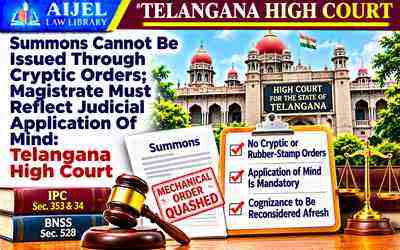
Summons Cannot Be Issued Through Cryptic Orders; Magistrate Must Reflect Judicial Application Of Mind While Taking Cognizance: Telangana High Court
2026 (0) AIJEL-HY 9808647
In a significant ruling, the High Court for the State of Telangana, presided over by Justice J. Sreenivas Rao, quashed the cognizance order issued by the Judicial First Class Magistrate at Thungathurthy, Suryapet District, in Criminal Case No. 328 of 2024. The petitioners, J. Raghu Ram and J. Sathaiah, challenged the order on the grounds that it was issued without adequate reasoning and failed to establish a prima facie case against them under Section 353 read with Section 34 of the Indian Penal Code (IPC).
The petitioners contended that the Magistrate had taken cognizance in a mechanical manner, without recording satisfaction or assigning any reasons for the issuance of summons. They argued that the complaint lodged by the second respondent did not meet the necessary legal requirements to constitute an offence under the IPC, as it lacked allegations of criminal force or assault.
During the hearing, the court noted that the learned Additional Public Prosecutor did not contest the submissions made by the petitioners. The court emphasized that the act of taking cognizance of an offence is a serious matter that requires the Magistrate to apply their mind to the allegations presented. Citing precedents from the Supreme Court, the court reiterated that a Magistrate must be satisfied that the allegations, if proven, would constitute an offence before issuing summons.
The court referred to the Supreme Court's ruling in the case of Sunil Bharati Mittal vs. Central Bureau of Investigation, which highlighted that cognizance cannot be taken based on cryptic orders lacking judicial reasoning. The court found that the Magistrate's order did not reflect any application of mind and was therefore liable to be quashed.
Consequently, the High Court quashed the cognizance order and directed the Magistrate to reconsider the matter in accordance with the law, ensuring that proper judicial standards are upheld in future proceedings. The criminal petition was disposed of, and any pending miscellaneous applications were closed.