
Public Servant Who Retired Before Cognizance Cannot Claim Sanction Protection Under Unamended Prevention Of Corruption Act: Patna High Court
2026 (0) AIJEL-PT 1773360
The Patna High Court, presided over by Justice Chandra Shekhar Jha, dismissed a petition filed by Narayan Prasad @ Narain Prasad seeking to quash an order dated September 7, 2015, by the Special Judge, Vigilance, North Bihar. The order had taken cognizance of offences under various sections of the Indian Penal Code and the Prevention of Corruption Act, 1988.
The case originated from a complaint filed by Shailendra Kumar in 2006, alleging that certain officials, including the petitioner, conspired to issue a possession certificate and facilitate an agricultural loan to an unauthorized person, causing wrongful loss to the complainant. Following an inquiry by the Vigilance authorities, an FIR was registered in 2010, leading to the investigation.
The petitioner contended that he merely performed his official duties by forwarding a report prepared by a Halka Karamchari, which had been based on land records. He argued that the loan was repaid with interest, implying no loss was incurred. Furthermore, he highlighted his long and unblemished service record prior to his retirement in 2013.
In contrast, the Vigilance Department's counsel argued that the evidence collected during the investigation warranted the continuation of the proceedings. The court noted that the petitioner’s claims regarding the correctness of the report and his bona fide actions could only be assessed during a trial.
The court emphasized that the jurisdiction under Section 482 of the Criminal Procedure Code is extraordinary and should be exercised sparingly. It reiterated that the High Court is not to conduct a mini-trial at this stage but to determine if there is sufficient material for the prosecution to proceed.
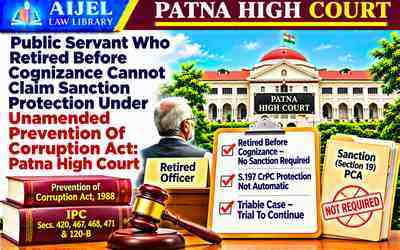
The court also referenced the Supreme Court's ruling in similar cases, clarifying that the protection under the Prevention of Corruption Act does not extend to individuals who have retired from public service at the time of cognizance. The court concluded that the allegations, if taken at face value, were not inherently improbable and required adjudication.
Ultimately, the High Court found no merit in the petition and dismissed it, allowing the trial court to proceed with the case in accordance with the law. The interim order, if any, was vacated, and the judgment was directed to be sent to the trial court forthwith.