
UAPA Bail Restrictions Cannot Override Constitutional Courts' Power To Protect Fundamental Rights; Supreme Court Grants Bail To Doctor After Over Four Years In Custody
2026 (0) AIJEL-SC 77944
In a significant ruling, the Supreme Court of India granted bail to Pawankumar Fakirchand Uike, who had been incarcerated for over four years under various charges, including those under the Unlawful Activities (Prevention) Act (UAPA). The appellant was arrested on July 28, 2022, in connection with FIR No. 02 of 2022, which alleged his involvement in unlawful activities in a Naxal-affected area of Maharashtra. The High Court had previously denied his bail application, citing the gravity of the allegations and his individual role in the offences.
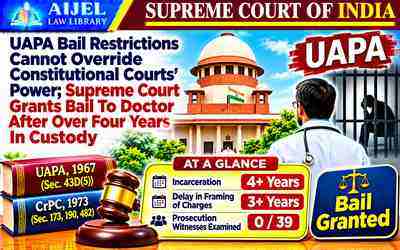
The Supreme Court, however, found that the prolonged delay in the trial process warranted a reconsideration of the bail application. The appellant's charges were framed only after more than three years from the committal of the case, and none of the 39 prosecution witnesses had been examined at the time of the ruling. The Court noted that the High Court had erroneously attributed the delay in trial to the appellant's alleged late surrender after a temporary bail period, which the Supreme Court clarified was not the case.
The Court highlighted that while the statutory embargo under Section 43D(5) of the UAPA applies when the material against the accused is prima facie true, it does not eliminate the discretionary power of Constitutional Courts to grant bail on grounds of fundamental rights violations, particularly in cases of undue delay in trial. The appellant's incarceration for over four years, coupled with the lack of progress in the trial, led the Court to conclude that he had made a strong case for bail.
The ruling emphasized that the appellant, a doctor by profession, could have had interactions with rebel factions in the course of his duties, which could not be entirely dismissed. The Court also noted that co-accused individuals apprehended alongside the appellant had been released on bail over two years prior, further supporting the appellant's claim for parity.
Ultimately, the Supreme Court directed the appellant to be released on bail, subject to conditions set by the trial court, and encouraged the Sessions Court to expedite the trial proceedings. The observations made in this order were limited to the bail application and were not intended to influence the ongoing trial.