
Murder Conviction Cannot Stand When Prosecution Fails to Identify Who Inflicted Fatal Injury; Benefit of Doubt Must Follow
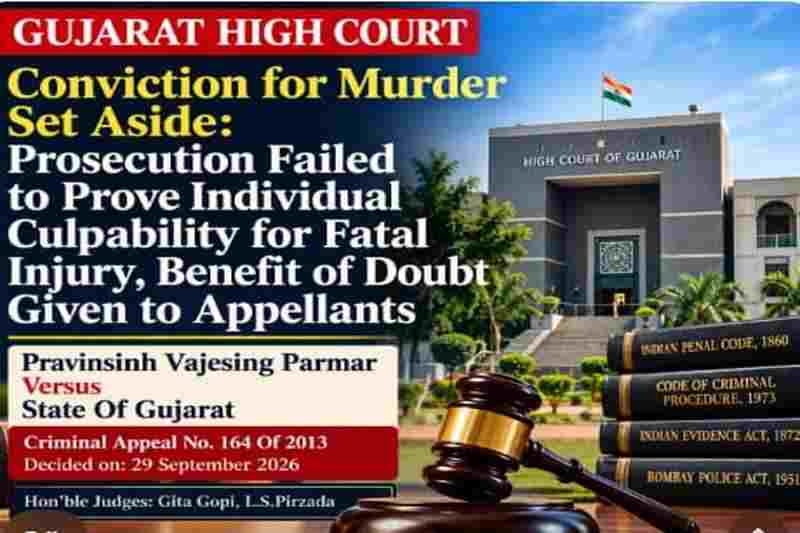
2026 (0) AIJEL-HC 254075
Decided: 29 September 2026
Coram: Gita Gopi & L.S. Pirzada, JJ.
The case arose from an incident on 2 January 2009 following a dispute between members of two families regarding a right of way. The earlier quarrel between the women of the two sides had apparently been settled. Later that evening, another confrontation took place in which Rajendrasinh suffered serious injuries. The prosecution alleged that accused No.1 Pravinsinh Parmar struck him on the head with a sickle and accused No.2 Tejendrasinh Parmar struck him with a sword. Rajendrasinh subsequently died during treatment.
There was also a cross-case arising from the same incident, and persons from the accused side had sustained injuries. Nine persons were originally tried, but accused Nos.3 to 9 were acquitted. The Trial Court did not accept the prosecution case regarding unlawful assembly and common object, yet convicted accused Nos.1 and 2 individually under Section 302 IPC, sentencing them to life imprisonment.
Judgment Summary
The Gujarat High Court found significant doubt about which accused actually caused the fatal injury. Although the prosecution alleged separate head blows by a sickle and a sword, the medical evidence disclosed only one relevant incised head injury, creating uncertainty regarding the individual role of each appellant.
The Court also considered that the incident involved a group clash/cross-case, that injuries had been suffered on both sides, and that the prosecution had failed to satisfactorily explain injuries sustained by the accused. The evidence did not establish the individual culpability of either appellant for the fatal injury beyond reasonable doubt.
Since the case of unlawful assembly/common object under Section 149 IPC had not been established, the individual acts of the appellants had to be independently proved. The evidence was insufficient to identify which appellant inflicted the fatal injury. The High Court therefore extended the benefit of doubt to both appellants.
Result: The appeals were allowed, and the convictions and sentences under Section 302 IPC and Section 135 of the Bombay Police Act were set aside, resulting in the appellants' acquittal.
Key Principle: Where common object is not proved and the prosecution cannot establish which accused individually inflicted the fatal injury, a murder conviction cannot rest on uncertainty; the accused are entitled to the benefit of reasonable doubt.