
Sanctity Is The Reward Of Legality’: Supreme Court Sets Aside SARFAESI Auction For Breach Of Mandatory Safeguards
2026 (0) AIJEL-SC 77693
The Court held that confirmation cannot protect an auction conducted in violation of statutory procedure and a tribunal’s restraint order.
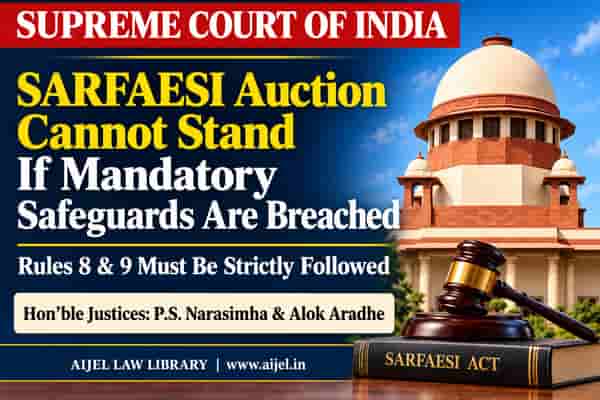
The Supreme Court has set aside the SARFAESI auction of an Ooty resort, holding that the finality ordinarily attached to confirmed auction sales presupposes a sale conducted in accordance with law.
A Bench of Justices P.S. Narasimha and Alok Aradhe overturned the Madras High Court judgment upholding the sale. Justice Alok Aradhe authored the judgment.
The dispute concerned IFCI’s sale of “The Fernhill”, a resort belonging to Sterling Holiday Resorts Limited. The borrower challenged the auction process and the sale certificate issued in favour of M/s P.M. Associates.
The Supreme Court identified several fundamental defects:
Bids received during a restraint: IFCI accepted a bid and earnest money while a DRAT order prohibited further SARFAESI proceedings. A subsequent favourable High Court judgment could not retrospectively validate that step.
Mandatory notice period curtailed: After excluding the period covered by the restraint, the borrower remained entitled to seventeen days of the thirty-day sale window. The sale and certificate preceded its expiry.
Borrower kept uninformed: Bids were opened without notifying the borrower, approximately seventeen months after the originally scheduled auction.
Certificate issued to a non-bidder: The successful bidder participated individually, but the certificate was issued to a nominee partnership firm that had not existed on the original auction date.
Auction records withheld: Original records and evidence of the required inter se bidding were not produced.
Emphasising that Rules 8 and 9 of the Security Interest (Enforcement) Rules are mandatory, the Court observed:
“Sanctity is the reward of legality, not a substitute for it.”
The dispute was examined under the statutory provisions applicable before the 2016 amendment to Section 13(8). The Court also stressed that deprivation of property must comply with the authority-of-law requirement under Article 300A.
The borrower’s appeals were allowed, and the purchaser’s appeals were dismissed. Having found the auction itself illegal, the Court left unresolved the separate questions concerning unilateral cancellation of the certificate, its registration and the precise redemption cutoff.