
Section 138 NI Act: Notice Need Not Be Personally Received By Cheque Drawer; Receipt By Family Member Does Not Defeat Service Presumption.
2026 (0) AIJEL-SC 77692
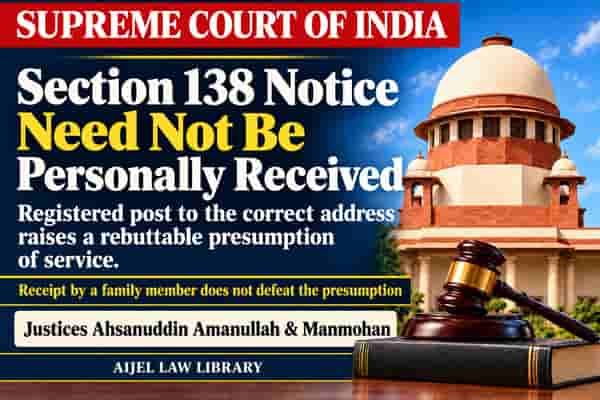
The Supreme Court has held that a statutory demand notice under Section 138 of the Negotiable Instruments Act need not be personally received by the cheque drawer. Sending the notice by registered post to the correct address raises a rebuttable presumption of service, which is not defeated merely because a family member receives it.
A Bench of Justices Ahsanuddin Amanullah and Manmohan set aside a Kerala High Court judgment that had reversed a cheque-bounce conviction because the demand notice was received by the accused’s mother.
The case concerned a dishonoured cheque issued towards repayment of a ₹3 lakh loan. The complainant sent the statutory notice by registered post to the accused’s correct residential address. Although his mother received it, no payment or reply followed. The trial court convicted the accused, and the appellate court upheld the conviction. The High Court subsequently reversed those findings on the question of notice.
The Supreme Court explained that Section 27 of the General Clauses Act, 1897 and Section 114 of the Evidence Act, 1872 support the presumption of service when a notice is properly dispatched to the correct address. The burden then falls on the drawer to rebut that presumption—for instance, by establishing an incorrect address, lack of knowledge of delivery, or an erroneous postal endorsement.
In this case, the accused appeared pursuant to summons delivered at the same address, which also appeared in his vakalatnama, appeal and revision petitions. He never disputed its correctness or claimed that he lived separately from his mother. The presumption therefore remained unrebutted.
The Court also declared M.D. Thomas v. P.S. Jaleel, (2009) 14 SCC 398, *per incuriam* for overlooking the binding three-judge Bench decision in C.C. Alavi Haji v. Palapetty Muhammed, (2007) 6 SCC 555. It held that the former decision could not be treated as binding precedent under Article 141.
Allowing the appeal, the Supreme Court restored the sentence of **six months’ simple imprisonment and a ₹3 lakh fine**, together with the default imprisonment stipulation.