
Employees’ Crystallised Rights Cannot Be Wiped Out By Subsequent CIRP; Court-Deposited Compensation Can Be Withdrawn By Workmen.
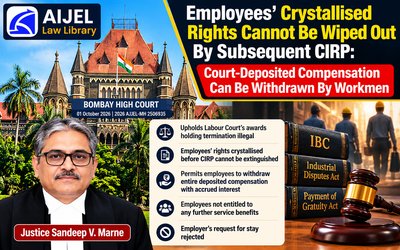
2026 (0) AIJEL-MH 2506935
The Bombay High Court has held that rights already crystallised in favour of employees under Labour Court awards cannot be extinguished merely because the employer subsequently undergoes Corporate Insolvency Resolution Process (CIRP).
Justice Sandeep V. Marne was considering cross-petitions arising from Labour Court awards concerning employees of Rolta India Limited. The employees had been dismissed through “charge-sheet-cum-dismissal” orders after disputes relating to their transfers to different cities.
The Court noted that the employer had dismissed the employees without conducting an inquiry and in gross violation of the principles of natural justice. It therefore upheld the Labour Court's finding that their termination was illegal.
The Labour Court had declined reinstatement, continuity of service and back wages, but awarded each employee ₹2.50 lakh compensation with 6% interest from December 21, 2005. Both sides initially challenged the awards, but the employees subsequently gave up their claims for reinstatement and back wages and expressed willingness to accept the compensation.
During the pendency of the proceedings, Rolta India Limited underwent CIRP. The new management argued that since the employees had not registered their claims before the Resolution Professional, their claims stood extinguished under the “clean slate” principle.
The High Court rejected this contention on the facts of the case. It distinguished cases where labour proceedings were still pending when CIRP commenced, observing that here the Labour Court had already adjudicated the employees' claims through awards dated February 7, 2011, whereas CIRP commenced only in January 2023.
Accordingly, the Court held that the employees' rights under the awards had already crystallised long before commencement of CIRP and approval of the resolution plan.
Court Deposit Belongs To Employees
The High Court made an important observation regarding money deposited in court by an employer while challenging a labour award.
The Court held that such deposits are intended to secure the employee's entitlement during the pendency of litigation and cannot automatically be reclaimed by the new management merely by invoking the clean-slate principle.
Justice Marne observed that treating such amounts as assets available to the corporate debtor could produce unjust consequences, particularly in cases involving statutory benefits such as gratuity.
Since the amounts in the present case had been deposited pursuant to Labour Court awards that had attained finality, the deposited money represented compensation payable to the employees.
The High Court consequently permitted all three employees to withdraw the entire amounts deposited before the Court together with accrued interest. However, after withdrawing those amounts, they would not be entitled to any additional service-related benefits from the employer.
The Court also rejected the employer's request to stay the operative part of the judgment for four weeks.