
Supreme Court: Separate Arbitration Agreements Cannot Be Overridden Merely By Earlier Parent Agreement; Arbitrator Appointed In India–South Korea Commercial Dispute
2026 (0) AIJEL-SC 77763
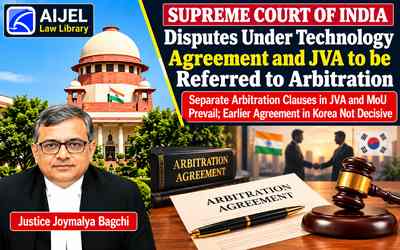
The Supreme Court has allowed two arbitration petitions filed by Shubham Equipment Private Limited and another against Rothwell Water Company Limited and others, holding that disputes arising under separate commercial agreements containing independent arbitration clauses can be referred to arbitration notwithstanding the existence of an earlier licence agreement providing for arbitration in South Korea.
The dispute arose from a business relationship involving wastewater treatment technology. The Indian and South Korean companies had executed a Technical Collaboration Licence Agreement in 2019, followed by a Joint Venture Agreement in 2021 and a Memorandum of Understanding in 2023.
While the original Licence Agreement provided for arbitration in Seoul, South Korea, the subsequent Joint Venture Agreement and MoU contained separate arbitration provisions providing for arbitration in Mumbai, India.
The respondents argued that the Licence Agreement was the principal or parent agreement and that its arbitration clause should govern all related disputes.
The Supreme Court rejected this contention at the referral stage, observing that the three agreements prima facie operated in different fields and that disputes arising exclusively under the Joint Venture Agreement and MoU were governed by their respective arbitration clauses.
The Court emphasised that Section 11(6-A) of the Arbitration and Conciliation Act, 1996 restricts the referral court's inquiry to the prima facie existence of an arbitration agreement. Questions concerning overlapping disputes and whether a non-signatory subsidiary was bound by the arbitration agreement were matters for the arbitrator.
Accordingly, the Supreme Court appointed Justice Ramesh Deokinandan Dhanuka, former Chief Justice of the Bombay High Court, as the sole arbitrator, allowing both arbitration petitions without an order as to costs.
Important legal points
1. Limited judicial intervention: Under Section 11(6-A), the referral court ordinarily examines only the prima facie existence of an arbitration agreement.
2. Independent arbitration clauses: Different agreements covering distinct commercial subjects may contain independently enforceable arbitration provisions.
3. Earlier agreement not automatically controlling: An earlier licence agreement providing for foreign arbitration does not necessarily override subsequent agreements containing separate arbitration clauses.
4. Overlapping disputes: Questions about the scope of disputes falling under different agreements may be determined by the arbitrator rather than preventing reference at the threshold.
5. Non-signatory parties: Whether a wholly owned subsidiary that did not sign the arbitration agreement is bound by it may require determination by the arbitrator.
6. Final decision: Both arbitration petitions allowed; Justice Ramesh Deokinandan Dhanuka appointed sole arbitrator.
Key takeaway: The existence of an earlier agreement providing for arbitration abroad does not, by itself, prevent Indian arbitration under separate agreements covering different subject matters.