
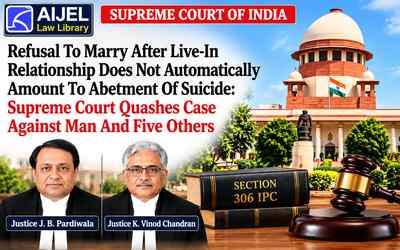
Refusal To Marry After Live-In Relationship Does Not Automatically Amount To Abetment Of Suicide: Supreme Court Quashes Case Against Man And Five Others
2026 (0) AIJEL-SC 77765
The Supreme Court has quashed criminal proceedings against six persons accused of abetment of suicide under Section 306 read with Section 34 of the Indian Penal Code, holding that refusal to marry following a consensual live-in relationship does not, by itself, establish the offence of abetment of suicide.
A Bench comprising Justices J.B. Pardiwala and K. Vinod Chandran considered a case involving a woman who died by suicide after her partner allegedly refused to marry her.
According to the complaint lodged by the deceased woman's sister, the couple had been in a consensual relationship and had lived together for approximately three months at the man's residence. The relationship had initially been accepted by his family.
The prosecution alleged that the man's family members and acquaintances influenced him against marrying the woman, following which she died by suicide.
The Supreme Court observed that although the death by suicide was undisputed, the allegations did not disclose any intentional instigation or conduct amounting to abetment by the accused persons.
The Bench emphasised that individuals may react differently to the breakdown of personal relationships, but such consequences cannot automatically result in criminal liability.
The Court held that refusal to marry was neither intended to drive the woman to suicide nor sufficient to attribute knowledge to the accused that she would take her own life.
Finding the allegations insufficient to sustain prosecution, the Supreme Court quashed Sessions Case No. 101 of 2024 pending before the competent court in Medchal-Malkajgiri District, Telangana.
The Court directed that the appellants, if in custody, be released forthwith unless required in another case, and ordered cancellation of their bail bonds if they were already on bail.
Important point: A failed relationship or refusal to marry, even when followed by suicide, does not automatically constitute abetment under Section 306 IPC in the absence of intentional instigation or other conduct amounting to abetment.