
Hindu Widow's Limited Property Rights Become Absolute Under Hindu Succession Act: Supreme Court Upholds Sons' Inheritance Of Delhi Agricultural Land.
2026 (0) AIJEL-SC 77768
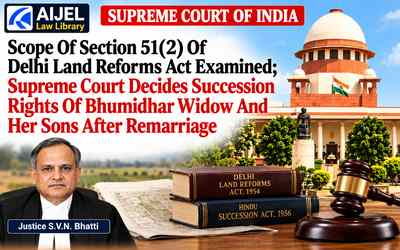
The Supreme Court has dismissed an appeal concerning inheritance of approximately 45 bighas of agricultural land in Delhi, holding that a Hindu widow's limited interest in property can become absolute ownership under Section 14(1) of the Hindu Succession Act, 1956, even where her Bhumidhari rights were recognised under the Delhi Land Reforms Act, 1954.
A Bench of Justices S.V.N. Bhatti and N.V. Anjaria examined the interpretation of Section 51(2) of the Delhi Land Reforms Act and its interaction with the Hindu Succession Act.
The dispute concerned Khajano, who had inherited an interest in agricultural land following the deaths of her first husband and son. She subsequently remarried and had two sons, Chand Ram and Chander Bhan, from her second marriage.
Khajano was recognised as a Bhumidhar under the Delhi Land Reforms Act, 1954. After her death in 1973, her two sons sought mutation of the agricultural holding in their names.
However, relatives claiming through the family of her first husband challenged the mutation, arguing that Khajano had inherited only a limited life estate and that the land should revert to the heirs of the last male holder under Section 50 of the Delhi Land Reforms Act.
The Supreme Court rejected this contention, holding that Section 14(1) of the Hindu Succession Act, 1956 enlarged Khajano's existing limited interest into absolute ownership before her death.
The Bench clarified that the expression “personal law applicable to her” under Section 51(2) of the Delhi Land Reforms Act refers to the law applicable when succession opens upon the female Bhumidhar's death, rather than freezing the applicable law as it stood in 1954.
The Court explained that where a female Bhumidhar holds only a life estate at the time of death, succession is governed by Section 50. However, where her interest has become absolute under the applicable personal law, succession follows Section 53 of the Delhi Land Reforms Act.
Since Khajano died in 1973, after the Hindu Succession Act had come into force, her interest had already become absolute. Accordingly, her agricultural holding was governed by Section 51(2)(a)(ii), read with Section 53, supporting the mutation in favour of her two sons.
The Supreme Court upheld the Delhi High Court Division Bench's decision and dismissed the appeal without costs.
Important legal point: A Hindu woman's limited estate recognised before 1956 may be enlarged into absolute ownership by Section 14(1) of the Hindu Succession Act. For succession under Section 51(2) of the Delhi Land Reforms Act, the nature of her interest and the personal law applicable at the time of her death are decisive.