
Handwriting Expert's Opinion Not Mandatory To Prove Genuineness Of Will; Courts Can Compare Disputed Signatures Themselves.
2026 (0) AIJEL-SC 77741
Expert evidence is only advisory and not binding on courts; Supreme Court sets aside Madhya Pradesh High Court's direction for compulsory handwriting examination in eviction dispute.
Case summary
The Supreme Court has held that obtaining a handwriting expert's opinion is not mandatory in every case involving a disputed Will, signature or handwriting, as courts possess the statutory authority to independently compare signatures and writings under Section 72 of the Bharatiya Sakshya Adhiniyam, 2023.
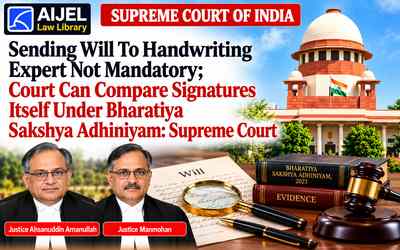
A Bench of Justices Ahsanuddin Amanullah and Manmohan allowed an appeal challenging the Madhya Pradesh High Court's direction to refer a disputed Will for expert examination in an eviction dispute.
The controversy arose when the respondents-tenants sought examination of a disputed Will by a handwriting expert to determine its genuineness. The Trial Court rejected the application, holding that it was competent to examine the document and decide whether expert assistance was necessary.
However, the Madhya Pradesh High Court reversed the Trial Court's decision and held that handwriting expert examination was essential for determining the Will's authenticity.
The Supreme Court disagreed, observing that Section 72 BSA expressly empowers courts to compare disputed signatures, writings and seals with admitted or proved specimens.
The Bench emphasised that courts cannot avoid their duty to independently evaluate disputed handwriting merely by stating that they are not experts. Expert evidence under Section 39 BSA is opinion evidence and does not bind the court.
At the same time, the Court clarified that judges retain discretion to obtain expert assistance where genuine doubts arise, particularly when the writing or impression is smudged, faint, vague or otherwise difficult to compare.
Distinguishing Thiruvengada Pillai v. Navaneethammal (2008) 4 SCC 530, the Supreme Court observed that the earlier case concerned disputed finger impressions and did not establish a mandatory requirement for expert examination in every dispute involving handwriting, signatures or fingerprints.
The Court found no infirmity in the Trial Court's approach and set aside the Madhya Pradesh High Court's order dated 27 October 2025, restoring the Trial Court's order dated 6 October 2025.
Since the underlying litigation concerned eviction, the Supreme Court also directed that the proceedings be expedited and concluded in accordance with law.
Important legal highlights
Court's independent power: Section 72 BSA authorises courts to compare disputed signatures and handwriting with admitted or proved specimens.
Expert opinion not compulsory: Section 39 BSA does not make expert examination mandatory in every dispute concerning a Will.
Expert evidence not binding: A handwriting expert's conclusion is advisory and does not replace judicial evaluation.
Judicial discretion: Courts may obtain expert assistance where doubts exist or the disputed writing is unclear.
Precedent distinguished: Thiruvengada Pillai does not impose a universal requirement for expert examination.
Final decision: Appeal allowed; High Court order set aside; Trial Court order restored.
The decision whether to refer a disputed Will or signature to a handwriting expert rests within the court's discretion; expert opinion cannot be treated as an indispensable requirement in every case.