
Judicial Officer Cannot Threaten To Sleep On Pavement Over Non-Allotment Of Government Quarters: Gujarat High Court Upholds Woman Judge's Dismissal
2026 (0) AIJEL-HC 254127
Judicial discipline and institutional dignity must be maintained; officer who deliberately avoids departmental inquiries cannot subsequently claim denial of natural justice, High Court holds.
Case summary
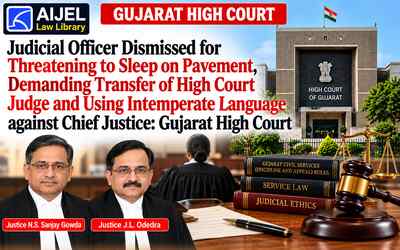
The Gujarat High Court has upheld the dismissal from service of a woman Senior Civil Judge, holding that threatening to spend the night on a public pavement over non-allotment of official accommodation and making insubordinate demands against senior judges constituted serious judicial misconduct.
A Division Bench comprising Justices N.S. Sanjay Gowda and J.L. Odedra dismissed a petition challenging the disciplinary action taken against the judicial officer.
The controversy arose after the officer was transferred from Vadodara to Deesa in October 2012. Upon being informed that judicial quarters were unavailable, she wrote to the Principal District Judge seeking permission to sleep on the pavement and demanding that the Collector be directed to requisition private accommodation.
The Court observed that a judicial officer is entitled to House Rent Allowance where official quarters are unavailable, but cannot insist on allotment of government accommodation as an absolute right.
The Bench found that the officer's conduct amounted to serious misconduct capable of undermining the dignity and reputation of the judiciary.
The disciplinary proceedings also concerned letters addressed to the Chief Justice, including one seeking a recommendation for the transfer of a sitting High Court Judge and another containing intemperate and discourteous language.
The High Court held that a subordinate judicial officer demanding the transfer of a sitting High Court Judge constituted grave insubordination and indiscipline.
The petitioner argued that the departmental inquiries violated principles of natural justice and that she had not received a fair opportunity to defend herself.
Rejecting this contention, the Bench noted that she had been granted opportunities to engage an advocate, obtain legal assistance, inspect records and respond to the inquiry reports, but had chosen not to participate in any of the three inquiries.
The Court observed that the charges were supported by oral, documentary and videographic evidence. The disciplinary findings had been considered by the Standing Committee and accepted by the Full Court.
The High Court concluded that the punishment of dismissal from judicial service was fully justified and did not warrant judicial interference.
Important legal highlights
Judicial discipline: Threatening public demonstrations to demand official accommodation can constitute serious misconduct.
Government quarters: A judicial officer cannot insist on allotment of official quarters as an absolute entitlement.
Insubordination: Demanding the transfer of a sitting High Court Judge and using undignified language against the Chief Justice constitute grave misconduct.
Natural justice: A delinquent officer who deliberately avoids inquiry proceedings despite reasonable opportunities cannot rely on that non-participation to establish denial of a fair hearing.
Final decision: Writ petition dismissed; dismissal from judicial service upheld.
Key takeaway: Judicial officers are required to maintain institutional dignity and discipline, and deliberate non-participation in disciplinary proceedings does not automatically invalidate an inquiry when adequate opportunities to defend have been provided.