
Electricity Board Cannot Recover Minimum Charges For 2000 KVA When It Failed To Supply Contracted Power Round The Clock.
2026 (0) AIJEL-HC 253962
Gujarat High Court rejects Electricity Board's ₹41.82 lakh recovery claim against industrial consumer, holding that contractual minimum demand charges cannot be sustained where the Board failed to provide the agreed continuous electricity supply.
Case summary
The Gujarat High Court has dismissed an appeal filed by the Gujarat Electricity Board seeking recovery of ₹41,82,789.79 from an industrial consumer, holding that the Board could not demand minimum electricity charges calculated on a contracted load of 2000 KVA when it had failed to provide that load continuously and round the clock.
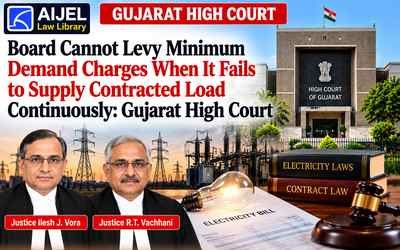
A Division Bench comprising Justices Ilesh J. Vora and R.T. Vachhani upheld the Trial Court's decision dismissing the Board's recovery suit.
The dispute arose after Mahendra Suting Ltd. entered into an agreement with the Electricity Board for supply of 2000 KVA electricity. However, due to technical limitations, the Board initially supplied only 500 KVA and subsequently offered additional power subject to restrictions, including supply during night hours.
The respondent company's manufacturing unit was classified as a Continuous Processing Industry, requiring uninterrupted electricity for 24 hours. The company consequently sought reduction of its contracted load to 500 KVA because the additional supply offered by the Board could not meet its operational requirements.
Despite these circumstances, the Board levied minimum demand charges calculated on the original contracted load of 2000 KVA and instituted recovery proceedings.
The High Court observed that the Board's own Executive Engineer admitted during cross-examination that it was unable to supply 2000 KVA continuously during the relevant period.
The Court further noted that supplying additional electricity only during night hours would interrupt the manufacturing process and would therefore be of no practical utility to the industrial consumer.
Another significant factor was the Board's acceptance of ₹81,664 towards cancellation or reduction of the additional 1500 KVA load. The Court found that the Board could not subsequently insist on minimum charges for the original 2000 KVA load without satisfactory evidence that the additional load had been restored.
The Bench also distinguished the Supreme Court's ruling in Bihar State Electricity Board v. Green Rubber Industries (1990) 1 SCC 731, explaining that the present dispute concerned the Board's failure to supply the contracted electricity, rather than a consumer's failure to utilise electricity that was available.
The High Court held that the Electricity Board had failed to establish its entitlement to levy minimum demand charges based on 2000 KVA.
Finding no reason to interfere with the Trial Court's appreciation of the evidence, the High Court dismissed the Board's appeal and upheld the rejection of its recovery claim.
Important legal highlights
Contracted electricity supply: Minimum demand charges based on 2000 KVA could not be sustained when the Board failed to supply that load continuously.
Continuous Processing Industry: Night-only additional electricity supply was inadequate for a manufacturing unit requiring uninterrupted power.
Reduction of contracted load: Acceptance of payment towards cancellation of additional load undermined the Board's subsequent claim for charges based on the original load.
Burden of proof: The Electricity Board failed to establish that the additional 1500 KVA had been restored.
Final decision: Appeal dismissed; Trial Court's rejection of the ₹41.82 lakh recovery suit upheld.
An electricity supplier cannot rely solely on minimum-demand provisions in a supply agreement to recover charges for contracted capacity that it failed to make available as agreed.