
Non-Signatories Can Be Included In Arbitration If Their Property Rights Are Affected: Supreme Court Allows Participation Of Subsequent Partners
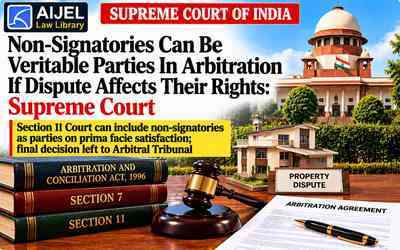
2026 (0) AIJEL-SC 77771
Supreme Court holds that persons who did not sign an arbitration agreement may nevertheless be necessary parties to the dispute, subject to the Arbitral Tribunal's final determination of their status, limitation and estoppel.
CASE SUMMARY
The Supreme Court has held that a person who has not signed an arbitration agreement may nevertheless be included in arbitration proceedings where the resolution of the dispute would substantially affect that person's rights.
A Bench comprising Justices J. B. Pardiwala and K. Vinod Chandran modified an order passed by the High Court in a dispute concerning ownership of commercial property in Mumbai and the successive reconstitution of a family partnership firm.
The dispute arose over Unit No. 2, measuring 3,500 square feet, at Manish Commercial Centre, Worli, Mumbai, originally acquired by M/s Prospective Traders, a partnership firm formed by three family trusts in 1977.
The partnership was reconstituted in 1985, when the appellants and the first two respondents were inducted as partners. Subsequently, a deed dated 3 July 1995 allegedly recorded the retirement of the appellants, which they disputed as a forged document.
Further changes in the partnership structure ultimately resulted in the third and fourth respondents becoming partners and claiming rights over the disputed property.
The appellants maintained that they had never validly retired from the partnership and that the property continued to belong to the earlier partnership arrangement.
The High Court had declined to include the subsequent partners in arbitration on the ground that they were not signatories to the 1985 partnership agreement containing the arbitration clause and did not fall within the recognised exceptions.
Examining the dispute, the Supreme Court referred to its Constitution Bench decision in Cox & Kings Ltd. v. SAP India Pvt. Ltd., (2024) 4 SCC 1, which recognised that the requirement of a written arbitration agreement under Section 7 does not necessarily exclude non-signatory parties from its operation.
The Court also considered Hindustan Petroleum Corporation Ltd. v. BCL Secure Premises Pvt. Ltd., (2026) 3 SCC 711, concerning the scope of examination by a referral court under Section 11.
The Bench explained that whether a non-signatory is a genuine or necessary party to arbitration depends on the particular facts, the relationship between the parties and the nature of the rights involved.
In the present case, the validity of the disputed retirement deed was central to determining ownership of the commercial property.
If the appellants' alleged retirement in 1995 was invalid, the subsequent partnership arrangements and the rights claimed by the third and fourth respondents could be directly affected.
The Supreme Court therefore held that the third and fourth respondents were prima facie veritable parties to the arbitration despite not having signed the original arbitration agreement.
However, the Court clarified that its conclusion was only preliminary and would not bind the Arbitral Tribunal.
The questions of whether the subsequent partners were ultimately bound by the arbitration agreement, whether the claims were barred by limitation and whether the appellants were prevented by estoppel from impleading them remained open for adjudication.
Accordingly, the Supreme Court modified the High Court's order to permit the third and fourth respondents to be treated as prima facie parties to the arbitration and disposed of the appeal.
IMPORTANT LEGAL HIGHLIGHTS
• Non-signatory parties: Persons who have not signed an arbitration agreement may still be brought into arbitration in appropriate circumstances.
• Property rights: A party whose rights in disputed property may be substantially affected can be considered a veritable party.
• Section 11 jurisdiction: A referral court may undertake a prima facie examination of whether a non-signatory is a genuine party to the dispute.
• Tribunal's authority: The final determination of the non-signatory's status remains with the Arbitral Tribunal.
• Limitation and estoppel: These objections remain open and must be decided independently.
• Final decision: High Court order modified; third and fourth respondents recognised as prima facie parties to the arbitration.
Non-signatory status alone does not automatically exclude a person from arbitration when the dispute directly affects that person's claimed rights. The referral court's preliminary assessment does not replace the Arbitral Tribunal's final decision.